Introduction: Why AI-Proof Jobs Matter More Than Ever
Artificial Intelligence is no longer a futuristic concept—it’s already reshaping industries, redefining roles, and forcing millions to rethink their career paths. From automation in factories to AI-driven customer service, the transformation is happening faster than many expected.
But here’s the real question:
Are you prepared for the future of work?
Search trends around AI-proof jobs, future jobs 2026, jobs AI cannot replace, and high demand careers are skyrocketing. People everywhere are asking the same thing:
“Which jobs are truly safe from AI?”
According to research from the Future of Jobs Report, while millions of roles will disappear, even more will evolve—especially those requiring human intelligence, empathy, and creativity.
This article explores the top AI-proof jobs in 2026 and beyond, helping you identify future-proof jobs that will be in demand by 2030.
What Makes a Job AI-Proof? (Understanding Jobs AI Cannot Replace)
Before diving into the list, it’s important to understand what separates AI-proof jobs from those at risk.
Core Traits of AI-Proof Careers
Jobs that AI cannot replace usually involve:
- Emotional intelligence (understanding human feelings)
- Creative thinking (original ideas and innovation)
- Complex problem-solving
- Human interaction and trust
- Unpredictable environments
In contrast, repetitive and rule-based jobs are the most vulnerable.
A study highlighted by McKinsey’s Future of Work insights confirms that automation will mainly affect routine tasks, not deeply human roles.
Quick Overview: AI-Proof Jobs vs AI-Replaced Jobs
| Category | AI-Proof Jobs | Jobs at Risk |
|---|---|---|
| Core Skill | Emotional Intelligence | Repetition |
| Work Style | Dynamic & Unpredictable | Routine & Structured |
| Examples | Therapist, Teacher | Data Entry Clerk |
| Human Interaction | High | Low |
| Creativity Level | High | Low |
Top AI-Proof Jobs in 2026 and Beyond (High Demand Careers)
The conversation around artificial intelligence often swings between excitement and fear. On one hand, AI is unlocking new possibilities; on the other, it’s raising serious concerns about job security. But here’s the reality: while some roles will fade, many others will grow stronger and more valuable—especially those rooted in human capability.
If you’re thinking about your future, the smartest move isn’t to avoid AI—it’s to understand where human strengths still dominate. That’s exactly what this guide is about.
Let’s explore the 12 powerful careers AI cannot replace, each offering strong growth potential through 2030 and beyond.
1. AI-Proof Jobs: Mental Health Professionals
Why It’s a High Demand Career
Mental health is no longer a silent issue. Across the world, more people are seeking help for stress, anxiety, depression, and burnout. As awareness grows, so does the need for qualified professionals who can provide meaningful support.
What They Do
- Help individuals manage emotional and psychological challenges
- Offer coping strategies for trauma, stress, and life transitions
- Build long-term therapeutic relationships
Why AI Can’t Replace It
Therapy is deeply human. It requires:
- Genuine empathy
- Emotional intuition
- Trust-building over time
AI may simulate conversation, but it cannot truly feel or understand human pain.
Future Outlook
This remains one of the best careers safe from AI automation 2026–2030, with demand expected to rise significantly.
2. AI-Proof Jobs: Healthcare Professionals
Why It’s a High Demand Career
Healthcare is essential in every society. As populations grow and age, the demand for doctors, nurses, and caregivers continues to increase.
Key Strengths
- Life-or-death decision-making
- Hands-on patient care
- Emotional reassurance for patients and families
Why It’s Future-Proof
AI can assist with diagnostics and data analysis, but it cannot replace:
- Human compassion
- Ethical responsibility
- Real-time clinical judgment
Future Outlook
Healthcare remains one of the most high paying jobs AI cannot replace in the future.
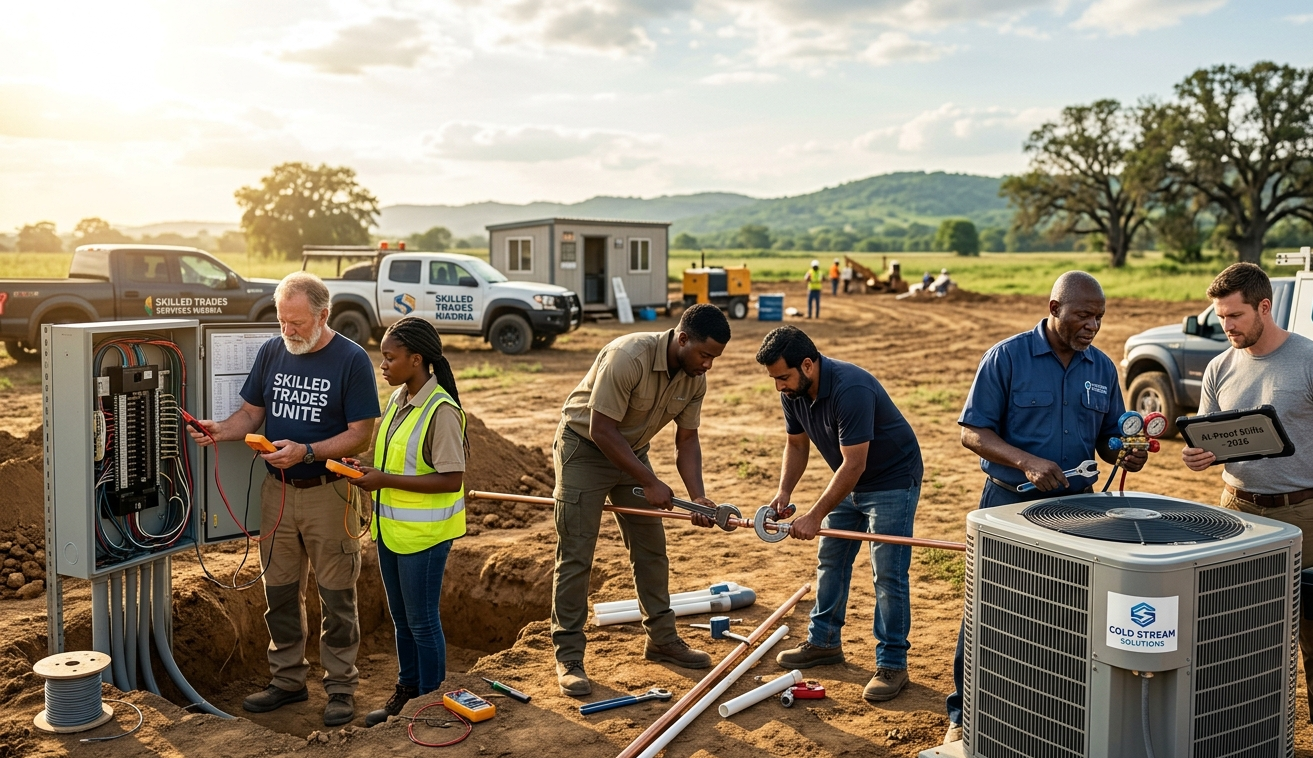
3. AI-Proof Jobs: Skilled Trades (Electricians, Plumbers)
Why These Jobs Matter
While many focus on digital careers, skilled trades remain the backbone of modern infrastructure.
Key Advantages
- Hands-on expertise
- Ability to work in unpredictable environments
- Immediate problem-solving on-site
Why AI Struggles Here
Robots and AI systems are limited in physical adaptability, especially in messy, real-world situations.
Future Trend
With increasing urbanization and infrastructure development, skilled trades are becoming high demand careers globally.
4. AI-Proof Jobs: Teachers and Educators
Role
Teachers do more than deliver lessons—they shape minds, inspire growth, and guide students through life.
Why AI Falls Short
- Cannot replicate human encouragement
- Lacks emotional awareness
- Cannot adapt deeply to individual student needs
Future Outlook
As education evolves, the role of teachers becomes even more important—not less.
5. AI-Proof Jobs: Creative Professionals
Includes:
- Writers
- Designers
- Artists
- Content creators
Why It’s Safe
AI can generate content, but it lacks:
- Personal experience
- Cultural understanding
- Emotional storytelling
The Human Edge
Creativity is not just about producing something new—it’s about expressing meaning, identity, and perspective.
6. AI-Proof Jobs: Leadership & Management Roles
What Makes Them Unique
- Strategic thinking
- Decision-making under uncertainty
- Motivating and managing people
Why AI Can’t Replace Leadership
Leadership is about:
- Vision
- Influence
- Trust
These are deeply human qualities that cannot be automated.
Future Outlook
Strong leaders will always be needed in every industry.
7. AI-Proof Jobs: Legal Professionals
Key Responsibilities
- Interpret laws
- Represent clients
- Negotiate outcomes
AI Limitations
Legal work involves:
- Ethical reasoning
- Persuasion
- Contextual judgment
Why It’s Safe
AI can analyze legal data, but it cannot replace human advocacy in complex legal situations.

8. AI-Proof Jobs: Emergency Responders
Includes:
- Firefighters
- Paramedics
- Rescue workers
Why They’re Irreplaceable
- Operate in high-risk environments
- Make split-second decisions
- Provide immediate, life-saving care
Human Factor
Courage, instinct, and adaptability are qualities AI cannot replicate.
9. AI-Proof Jobs: Human Resource Specialists
Role
HR professionals manage:
- Hiring
- Employee relations
- Workplace culture
Why It’s Safe
Human behavior is complex and unpredictable. Managing people requires:
- Emotional intelligence
- Conflict resolution
- Cultural awareness
Future Outlook
As workplaces evolve, HR becomes even more critical.
10. AI-Proof Jobs: UX Designers
Focus
Designing products that feel intuitive and user-friendly.
Key Strength
Understanding how humans think, feel, and interact with technology.
Why AI Can’t Replace It
AI can analyze user data—but it cannot fully understand:
- Human frustration
- Emotional responses
- Subtle user behavior
11. AI-Proof Jobs: Community Development Professionals
Role
These professionals work to improve communities by addressing social and economic challenges.
Why AI Can’t Replace It
- Requires trust-building
- Involves cultural sensitivity
- Depends on human relationships
Future Outlook
As societies grow more complex, this role becomes increasingly important.
12. AI-Proof Jobs: Ethical AI Specialists
Emerging Career
This is one of the most exciting future jobs 2026.
Role
- Ensure AI systems are fair and unbiased
- Address ethical concerns in technology
- Guide responsible AI development
Why It’s Critical
AI needs human oversight to ensure it aligns with societal values.
Key Insights: Future Jobs 2026 You Should Pay Attention To
The future of work isn’t about humans vs AI—it’s about humans working with AI.
Top Trends Shaping High Demand Careers
- AI will augment jobs, not replace them entirely
- Human skills will become more valuable than technical skills
- Hybrid roles (AI + human skills) will dominate
This means your goal shouldn’t be to avoid AI—but to develop skills that complement it.
How to Choose the Best AI-Proof Career Path
Choosing a career in this new era requires self-awareness and strategy.
Ask Yourself:
- Do I enjoy working with people?
- Can I handle complex, unpredictable situations?
- Am I creative or emotionally intelligent?
Top Skills to Develop
To stay competitive in future-proof jobs that will be in demand by 2030, focus on:
- Communication: Clear and effective interaction
- Critical thinking: Making informed decisions
- Adaptability: Adjusting to change quickly
- Emotional intelligence: Understanding people
These skills are your long-term career insurance.
Future-Proof Jobs That Will Be in Demand by 2030
As the world moves deeper into the age of automation and artificial intelligence, one truth is becoming increasingly clear: job security is no longer about choosing the “right industry”—it’s about developing the right combination of skills.
In the past, people could rely on stable industries to build lifelong careers. Today, that model is rapidly changing. Entire sectors are being transformed by technology, and roles that once seemed secure are evolving—or disappearing altogether. This shift has made many people rethink what it truly means to have a “safe” career.
The answer lies not in avoiding change, but in understanding it.
The most resilient and future-proof jobs that will be in demand by 2030 are those built on a powerful blend of human-centered skills—skills that technology can support, but not replace.
The New Reality: Skills Over Job Titles
Instead of asking, “Which job is safe?”, a better question is:
“What skills will always be valuable, no matter how the world changes?”
This mindset shift is crucial. Why? Because industries may evolve, but core human abilities remain relevant across all fields.
A healthcare worker, a teacher, a business leader, and a creative professional may work in completely different environments—but they often share the same foundational strengths. These strengths form what we can call the Winning Career Formula.
Winning Career Formula
1. Human Interaction + Problem-Solving
At the heart of every meaningful career is the ability to work with people and solve real-world problems.
Human interaction involves:
- Building relationships
- Communicating effectively
- Understanding emotions and perspectives
Problem-solving, on the other hand, requires:
- Analytical thinking
- Creativity in finding solutions
- The ability to navigate uncertainty
When combined, these skills create professionals who can handle complex, real-life situations—something AI struggles to do. For example, a doctor doesn’t just diagnose illness; they must also communicate with patients, understand their concerns, and make decisions in unpredictable scenarios. Similarly, a business consultant must analyze challenges while also managing client relationships.
This combination ensures that your role remains valuable, even as technology evolves.
2. Creativity + Adaptability
Creativity is often misunderstood as something limited to artists or designers. In reality, it’s a universal skill that applies to nearly every profession.
Creativity means:
- Thinking differently
- Generating new ideas
- Finding innovative solutions
Adaptability complements creativity by allowing you to:
- Adjust to change
- Learn new tools and systems
- Stay relevant in a shifting environment
Together, these skills make you resilient. In a world where AI can replicate patterns, creativity allows you to break them. And when change inevitably happens, adaptability ensures you can pivot rather than fall behind.
Consider industries like marketing, technology, or education. The tools and platforms may change constantly, but professionals who can think creatively and adapt quickly will always find opportunities.
3. Ethics + Leadership
As technology becomes more powerful, ethical considerations become more important. AI can make decisions based on data, but it cannot determine what is morally right or socially responsible. That responsibility falls on humans.
Ethics involves:
- Making fair and responsible decisions
- Understanding the impact of actions on others
- Upholding integrity in complex situations
Leadership builds on this by enabling you to:
- Guide teams and organizations
- Inspire and motivate others
- Make strategic decisions under pressure
In the future, leaders will not just manage systems—they will manage the intersection of technology and humanity. Whether in business, healthcare, or government, ethical leadership will be one of the most valuable traits in the workforce.
Why This Formula Works
When your career includes these elements—human interaction, problem-solving, creativity, adaptability, ethics, and leadership—you become more than just an employee. You become someone who can navigate complexity, drive change, and create value in ways that machines cannot.
This is what makes a career truly future-proof.
AI may handle repetitive tasks, analyze data, and improve efficiency. But it still depends on humans to:
- Interpret results
- Make judgment calls
- Build relationships
- Create meaning
In other words, technology amplifies human ability—it doesn’t replace it.
Looking Ahead to 2030
By 2030, the job market will likely look very different from today. New roles will emerge, existing ones will evolve, and some will disappear. But one thing will remain constant: the demand for people who can combine technical awareness with human intelligence.
To stay ahead, focus on continuous growth:
- Learn how to use new tools, including AI
- Strengthen your communication and leadership skills
- Stay curious and open to change
The goal is not to predict the future perfectly—but to prepare yourself to thrive in any version of it.
The safest careers are not tied to a single job title or industry. They are built on a foundation of transferable, human-centered skills that remain valuable no matter how the world evolves.
If your career reflects the winning formula—
human interaction + problem-solving, creativity + adaptability, ethics + leadership—
then you’re not just preparing for the future.
You’re positioning yourself to lead it.
Conclusion: The Future Belongs to Humans Who Adapt
Artificial Intelligence is, without a doubt, one of the most powerful forces shaping the modern world. It can analyze massive amounts of data in seconds, automate repetitive tasks with precision, and even simulate conversations that feel surprisingly human. From healthcare diagnostics to business analytics, AI is transforming how we live and work at an unprecedented pace.
But despite all its capabilities, there’s one fundamental truth that often gets overlooked:
AI is powerful—but it’s not human.
It operates based on patterns, algorithms, and data. It learns from what already exists. But it does not truly understand the human condition. It does not feel joy, pain, fear, or hope. And that distinction is more important than ever when thinking about the future of work.
AI can process information, but it cannot feel empathy—the ability to genuinely understand and share another person’s emotions. It can generate responses, but it cannot build trust in the way a human can through authenticity and shared experience. It can follow programmed guidelines, but it cannot make ethical decisions rooted in moral reasoning and cultural context. And while it can mimic creativity, it cannot truly understand human experience—the depth of perspective shaped by life, relationships, and emotion.
That’s where you come in.
The future isn’t about humans being replaced—it’s about humans being redefined. The most secure and successful careers won’t be the ones that try to compete with AI in speed or efficiency. Instead, they will be the ones that leverage human strengths alongside technology.
Think of AI as a tool—not a competitor. Just as calculators didn’t replace mathematicians and computers didn’t eliminate writers, AI will not eliminate the need for human contribution. What it will do is change how we work, pushing us to focus on what we do best.
So instead of fearing the future, the smarter approach is to prepare for it intentionally.
Start by investing in the qualities that make you uniquely human:
- People skills: The ability to connect, communicate, and collaborate effectively will always be in demand. Whether you’re leading a team, helping a client, or teaching a student, strong interpersonal skills will set you apart in any field.
- Creativity: In a world where machines can replicate patterns, originality becomes even more valuable. Creativity allows you to innovate, solve problems in new ways, and bring fresh ideas to life. It’s the driving force behind progress in every industry.
- Real-world problem-solving: Life is unpredictable, and not every situation has a clear set of rules. The ability to think critically, adapt quickly, and find solutions in complex scenarios is something AI still struggles to replicate.
These are not just “soft skills”—they are essential survival skills for the future economy.
It’s also important to embrace change rather than resist it. The world of work has always evolved, from the industrial revolution to the digital age. Each transformation created uncertainty, but it also created opportunity. AI is simply the next chapter in that ongoing story.
Those who thrive will be the ones who stay curious, keep learning, and remain flexible. They will see AI not as a threat, but as a partner that can enhance their capabilities. They will continuously upgrade their skills, explore new opportunities, and adapt to shifting demands.
And perhaps most importantly, they will understand that being human is their greatest advantage.
Because in the end, the future doesn’t belong to machines.
It belongs to the individuals who can combine intelligence with empathy, logic with creativity, and technology with humanity. It belongs to those who are willing to grow, evolve, and step confidently into a changing world.
So don’t focus on what AI can do.
Focus on what only you can do.
That’s where your true power lies—and that’s what will secure your place in the future.
It belongs to humans who know how to adapt.
FAQs About AI-Proof Jobs (Expanded Guide)
1. What are AI-proof jobs?
AI-proof jobs are roles that rely heavily on uniquely human abilities—skills that machines, no matter how advanced, struggle to replicate. These include empathy, creativity, ethical judgment, complex decision-making, and interpersonal communication. While AI excels at processing data, identifying patterns, and automating repetitive tasks, it lacks genuine emotional understanding and human experience.
For example, a therapist doesn’t just analyze behavior—they build trust, interpret emotions, and respond with compassion. Similarly, a teacher adapts lessons based on the mood, learning pace, and personality of each student. These subtle human dynamics make such roles extremely difficult to automate.
In simple terms, AI-proof jobs are not just about what you do, but how you do it. If your work involves connecting with people, solving unpredictable problems, or thinking creatively, it is far more likely to remain relevant in the future.
2. Which jobs are safest from AI?
The safest jobs from AI are those that combine human interaction, adaptability, and real-world complexity. These include:
- Healthcare roles (doctors, nurses, caregivers): They require hands-on care, empathy, and critical decision-making.
- Education professionals (teachers, mentors): Teaching goes beyond delivering information—it involves inspiration and guidance.
- Skilled trades (electricians, plumbers, mechanics): These jobs require physical work in unpredictable environments.
- Leadership roles (managers, executives): Leadership involves vision, emotional intelligence, and decision-making under uncertainty.
Additionally, careers in creative industries, social work, and emergency response are also highly resistant to automation.
What ties these roles together is their reliance on human judgment and adaptability. Even when AI tools are introduced, they typically serve as assistants rather than replacements.
3. Will AI replace all jobs by 2030?
No, AI will not replace all jobs by 2030—but it will significantly reshape the job market. The more accurate perspective is this: AI will transform jobs, not eliminate them entirely.
Many routine tasks within jobs will be automated, freeing up humans to focus on higher-value responsibilities. For example:
- Accountants may rely on AI for calculations but still provide financial strategy.
- Doctors may use AI for diagnosis support but remain responsible for patient care decisions.
- Writers may use AI tools for drafting ideas but still shape the narrative and voice.
This shift means that instead of disappearing, many roles will evolve into hybrid positions, combining technical tools with human expertise.
However, jobs that are purely repetitive or rule-based—such as basic data entry or simple customer support—are at higher risk. The key to staying relevant is adaptability.
4. What skills are future-proof?
Future-proof skills are those that remain valuable regardless of technological change. These skills are deeply human and difficult for AI to replicate:
- Emotional intelligence: The ability to understand, manage, and respond to emotions—both yours and others’. This is essential in leadership, healthcare, and customer-facing roles.
- Creativity: Generating original ideas, thinking outside the box, and innovating solutions. Creativity drives industries like marketing, design, and entrepreneurship.
- Critical thinking: The ability to analyze complex situations, evaluate information, and make sound decisions. This skill is crucial in almost every profession.
Beyond these, other important future-proof skills include:
- Communication: Clearly expressing ideas and building relationships
- Adaptability: Adjusting quickly to change and learning new tools
- Problem-solving: Tackling challenges that don’t have clear or immediate answers
Developing these skills ensures that you can work alongside AI rather than compete with it.
5. Are AI jobs still worth pursuing?
Absolutely—AI-related jobs are not only worth pursuing, but they are also among the fastest-growing career paths globally. However, the most valuable roles are not purely technical—they are hybrid roles that combine AI knowledge with human insight.
Examples include:
- AI product managers who bridge technology and user needs
- AI ethics specialists who ensure responsible use of technology
- Data analysts who interpret insights and guide business decisions
The key advantage here is that while AI can process data, it still relies on humans to interpret results, make ethical decisions, and apply insights in real-world contexts.
In fact, the future job market favors individuals who can understand AI tools and use them effectively, rather than those who avoid them entirely.
So instead of asking, “Should I go into AI?”, a better question is:
👉 “How can I combine AI skills with human strengths?”
That’s where the real opportunity lies—and where long-term career security is strongest.
AI-proof jobs, future jobs 2026, jobs AI cannot replace, high demand careers, top AI-proof jobs in 2026 and beyond, high paying jobs AI cannot replace in the future.